

If your business is in Des Moines, Ankeny, or anywhere across central Iowa, you have likely seen the offer: a free security assessment. It sounds useful, but what actually happens during that visit, and what do you get when it ends? Many owners searching for managed IT services near me start with that question, and the answer says a lot about whether the offer is a real inspection or a sales call in disguise.
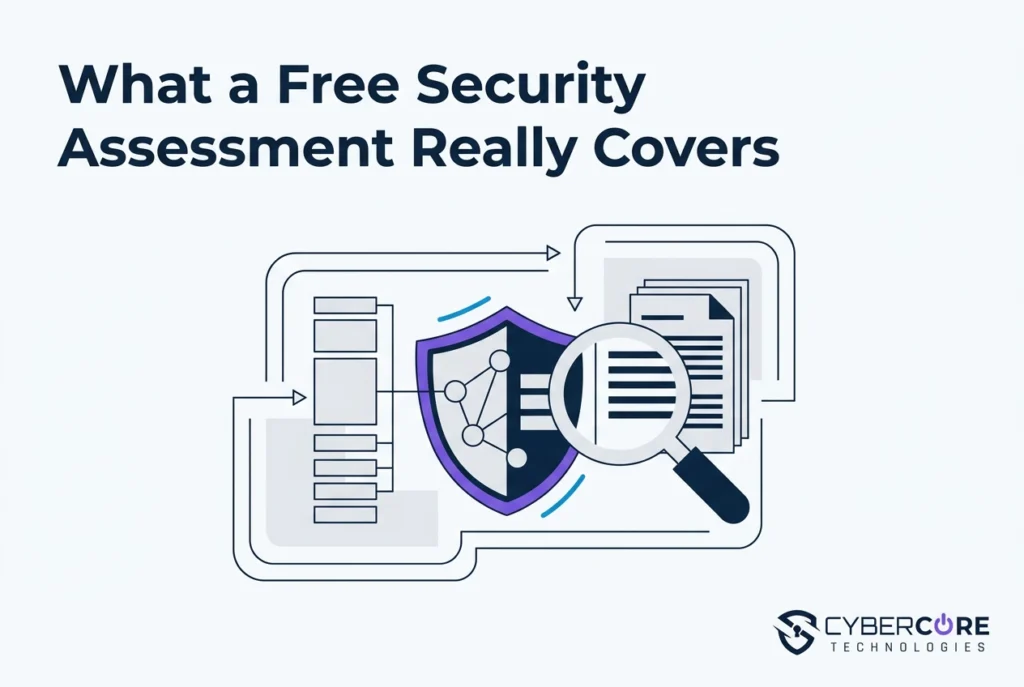
This tutorial walks through what a credible assessment covers, so you can judge any provider’s version on your own. We will look at what gets checked first, including sign-in protection, admin and stale accounts, device coverage, email authentication records, backup restore testing, and internet-facing services. You will see what a written findings report should include, what a free assessment honestly cannot tell you, and how to compare one provider’s offer against another.
From there, we will cover fixing gaps in priority order and how CyberCore Technologies approaches these conversations with clients in Norwalk, West Des Moines, Urbandale, Waukee, Altoona, and nearby communities.
What a Credible Security Assessment Is, and What It Is Not
A credible assessment follows a written, repeatable method. NIST SP 800-30 Rev. 1 (September 2012) describes a structured risk assessment process that nongovernmental organizations may use voluntarily. Expect an inspection, not a pitch: questions and notes about your accounts, devices, backups, and internet connections, not a quote first. NIST Cybersecurity Framework 2.0 (February 26, 2024) applies to any size or maturity and centers on understanding, assessing, prioritizing, and communicating risk, so expect priorities, not a score. You should not need internal IT staff; a process requiring a server room and a dedicated administrator is not built for a 20-person practice in Norwalk. Free still means documented: the report is yours to keep, whether or not you hire afterward. See how your organization measures up with a free security assessment.
Accounts and Sign-In Protection: What Gets Checked First
Sign-in controls come first, since a stolen password, often taken through a phishing email, is the cheapest way in.
- Multi-factor authentication coverage: what share of sign-ins require a second step, like a code, app approval, or security key, and which accounts skip it. Gaps sit on mailboxes, remote access, and shared logins.
- Administrator accounts: how many exist, who holds them, and whether everyday email and browsing happen on a standard account instead of an admin one.
- Stale and dormant accounts: former employees, seasonal staff, old shared mailboxes, and vendor logins that still work.
- Offboarding: is removing access a written step, or something everyone remembers differently?
- Outside access: which vendors, contractors, and guests can reach your systems, how that access is approved, and when it is supposed to end.
Devices, Email, Backups, and Internet-Facing Services
With accounts covered, the inspection turns to systems behind them.
Endpoint coverage. Assessors count devices with protection installed and reporting in, then compare them against every device in use. The gap is the finding. Most gaps trace to antivirus alone; endpoint detection and response watches behavior, not just known threats.
Email authentication. Does your domain publish records telling receiving servers your mail is legitimate? Without them, spoofing your address gets easier.
Backup restore testing. Has anyone actually restored and verified a backup, or do reports only say completed?
Internet-facing exposure. Remote access tools, file shares, and management interfaces reachable from the open internet, plus anything an outside scan sees unauthenticated.
Updates and network basics. Patch gaps, wireless settings, guest network separation, and a firewall between you and the internet.
What the Written Findings Should Look Like
Once the inspection ends, the written report is the deliverable. Expect Clear Findings, Ranked by Risk, not a slide deck.
- A plain-language executive summary an owner or office manager can read in a few minutes.
- A technical list for whoever does the fixing, naming the specific account, device, or setting so nothing is re-investigated.
- Findings as consequences: not “email authentication missing,” but “someone could send mail pretending to be your firm.”
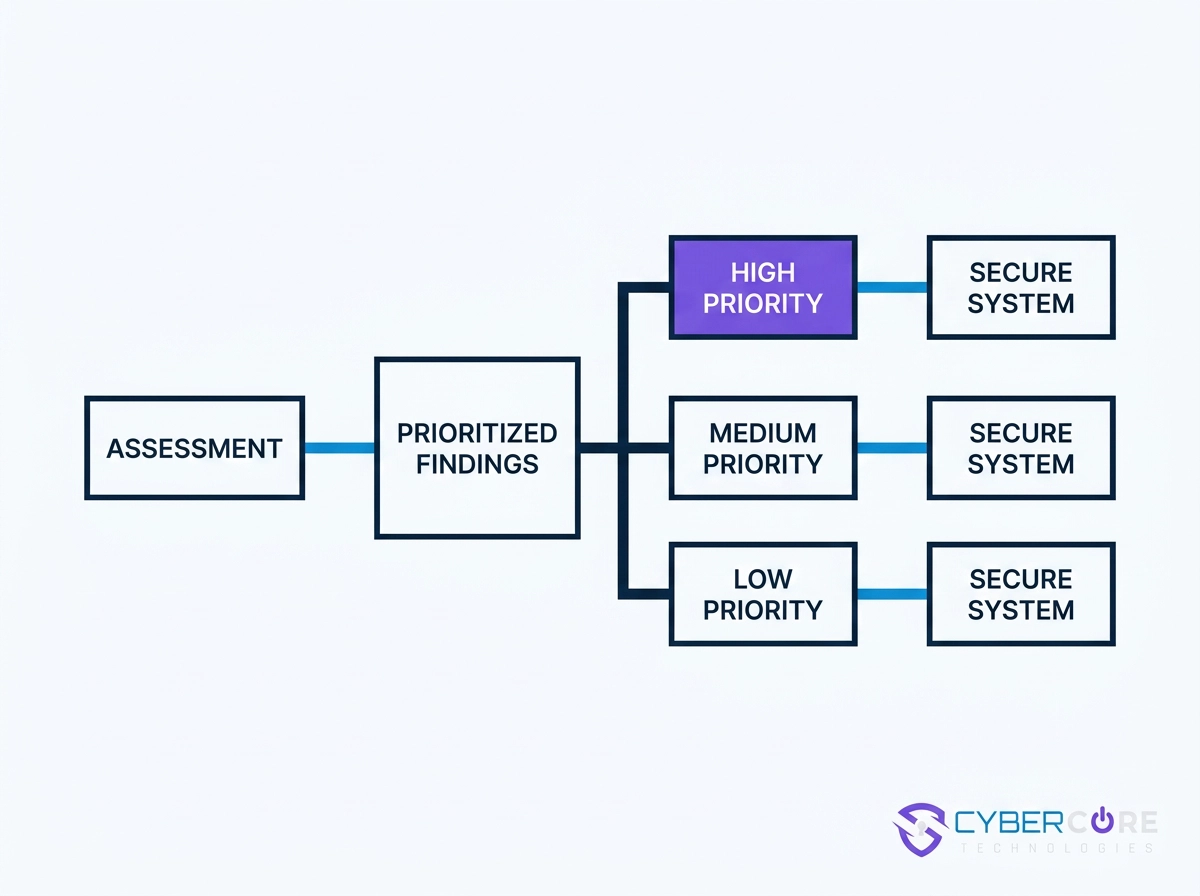
- A priority order. NIST CSF 2.0 centers on prioritizing and communicating risk; a flat list of 40 items is not a priority order.
- Scope and date stated plainly: what was inspected, what wasn’t, and when, since findings go stale as accounts and devices change.
What a Free Assessment Cannot Tell You
The dated report is a baseline. It captures one day; accounts, devices, or settings changed afterward are not reflected.
An assessment cannot certify compliance. HIPAA, PCI DSS, and the FTC Safeguards Rule each carry their own requirements. CyberCore Technologies helps clients build compliant programs. No assessment makes a business compliant, and regulatory questions belong with your legal counsel.
It does not replace continuous monitoring. An inspection checks configurations and coverage; it does not watch activity over time, which catches a quietly compromised account.
Habits do not show up in a walkthrough. Phishing recognition and password reuse appear over months of training and simulated phishing.
It is limited by what it can reach. If logins or documentation are unavailable, findings should say so, not guess. Start with a free security assessment.
How to Compare Another Provider’s Free Security Assessment
Given those limits, compare providers the same way.
Ask for the scope in writing: which systems, how long, and what you receive at the end. A verbal plan is not a scope. Ask who does the work, their experience, and what happens to your data.
Compare deliverables, not presentations. Two free assessments can look identical in the meeting; only one produces a report you can keep and act on. Searches for managed it services near me or managed it services providers near me return long lists of similar pages; a shared checklist makes them comparable.
Can the work be done in phases, and do you keep the report to share with your staff or another provider? A provider who resists is telling you something. Start with a free security assessment.
Fixing Gaps in Priority Order
Once the report arrives, sequence matters more than speed. Turn on MFA for email and remote access, remove accounts that no longer belong to anyone, and confirm a backup actually restores.
Next, shrink outside reach: close or restrict internet-exposed remote access and file shares, and clear the update backlog. Then widen coverage: protection and monitoring on every device, email filtering, and alerts with an assigned reviewer. Finally, build habits: awareness training, simulated phishing, a written offboarding step, and a named owner for each recurring task.
Resist buying the largest package first. Fixing documented gaps in order, then reassessing, gives you a baseline and ties spending to results. The break-fix model leaves no one owning follow-through. Des Moines metro clients onboard with CyberCore Technologies in phases under their service agreement.
Your Next Step
As you work through those gaps, hold any free assessment to one standard: a written scope before the visit, a documented inspection, and a report you keep, with findings in priority order. Fix the top items first, then reassess, so you can see what changed instead of guessing.
If you’re comparing providers across Ankeny, Altoona, Urbandale, Waukee, or anywhere in central Iowa, ask each the same questions, and involve legal counsel when HIPAA, PCI DSS, or the FTC Safeguards Rule applies. Reading what your IT provider’s cybersecurity credentials mean for your business can help you judge the person doing the work.
To see what CyberCore Technologies inspects first and how the written findings look, reach out whenever convenient. No pressure and no pitch before the inspection.
Conclusion
A free security assessment is only as useful as the paperwork behind it. Expect a written scope before anyone walks in, a documented inspection of accounts, devices, email, backups, and internet-facing services, and a report you keep, with findings in priority order.
The pattern that works is simple: fix the top documented gaps, reassess, and let results guide the next round of spending instead of buying the largest package upfront.
Ask every provider the same questions, and involve legal counsel when HIPAA, PCI DSS, or the FTC Safeguards Rule applies.
When you want to see what CyberCore Technologies inspects first and how the written findings look, reach out to CyberCore whenever convenient. No pressure and no pitch before the inspection.