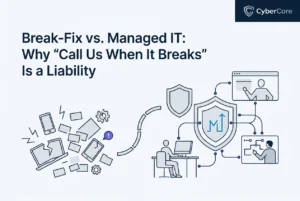


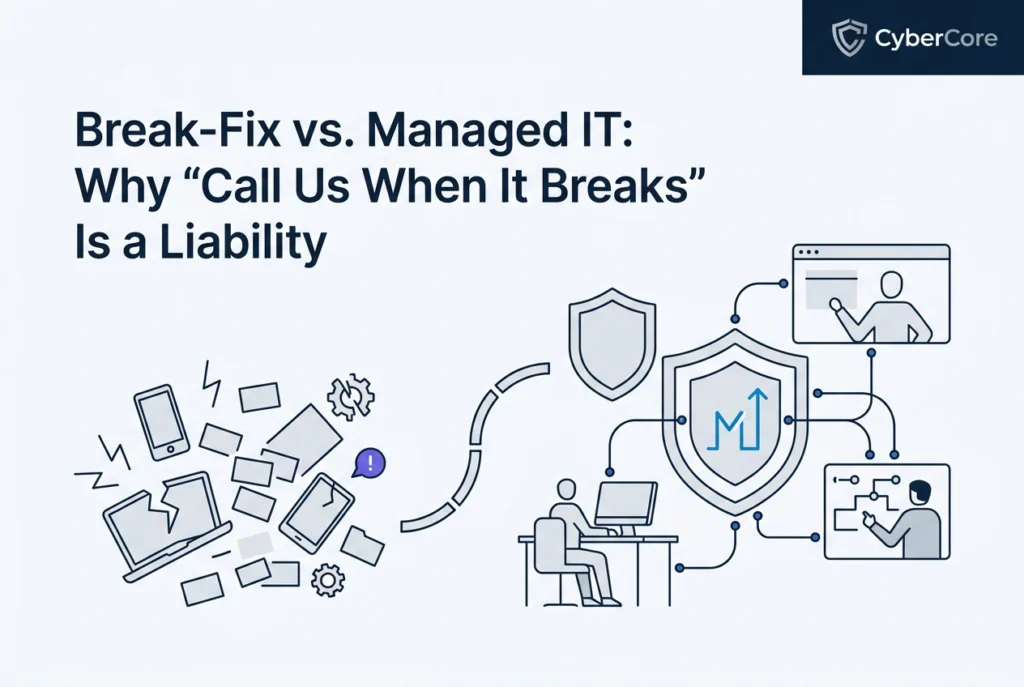
“We only call our IT guy when something breaks, and that works fine for us.” It’s one of the most common things small business owners say about their technology. It sounds sensible. There’s no monthly bill, no contract, and you only pay when there’s a problem.
The trouble is that break-fix IT isn’t really a budget decision. It’s a risk decision, and most businesses make it without realizing what they’re agreeing to. This post looks at why the break-fix model works against you, what it quietly costs, and why the usual reasons for sticking with it don’t hold up.
The Incentive Problem
Every business model rewards something. Break-fix rewards problems.
A break-fix vendor earns money when your systems fail. If they prevented every issue, kept every computer updated, and caught every warning sign early, they would have nothing to bill for. That doesn’t mean break-fix technicians are dishonest. Many are skilled and well-intentioned. It means the arrangement itself gives no one a reason to prevent problems, because prevention isn’t part of the deal.
Between calls, nobody is responsible for your systems. Nobody is watching for a failing hard drive, applying security updates, checking that backups actually work, or noticing a login from an unfamiliar location. Those tasks simply don’t happen.
What Break-Fix Actually Costs
Break-fix feels cheaper because its costs are hidden until the moment they arrive all at once.
Picture a 15-person accounting office on a Friday afternoon in the middle of tax season. The file server stops responding. Nobody was monitoring it, so the warning signs that had been building for weeks went unnoticed. The office calls its IT vendor and leaves a message. By the time someone looks at the problem, the firm has lost billable hours, pushed back client deadlines, paid rush pricing for replacement hardware, and possibly paid for data recovery because the backup had never been tested.
None of that shows up as a line item labeled “break-fix.” But every dollar of it is a cost of the model. And because no one addresses the root causes afterward, the conditions that led to the failure are still there, setting up the next one.
The Security Gap
Today, the biggest cost of break-fix usually isn’t hardware. It’s security.
Most attacks on small businesses take advantage of things that ongoing IT management is designed to handle: missing updates, accounts without multi-factor authentication, former employees who still have access, and staff who haven’t been shown what a phishing email looks like. Under break-fix, those gaps stay open because there’s no one whose job is to close them.
Break-fix also means no one is watching when something suspicious happens. If an attacker gets into an email account on a Saturday, there’s no alert and no response. The first sign may be a client asking why they received a strange invoice from your address, or files that suddenly won’t open.
The Compliance Gap
For healthcare practices, law firms, accounting firms, and other regulated organizations, break-fix creates a second problem: it produces no evidence.
HIPAA, the FTC Safeguards Rule, and PCI DSS expect ongoing, documented security practices. If a regulator or auditor asks how you manage updates, who has access to sensitive data, or how you’d respond to an incident, a folder of repair invoices won’t answer those questions. And when something goes wrong, the responsibility belongs to your organization, not your vendor.
The Objections We Hear, and Why They Don’t Hold Up
“We rarely have problems.”
That may be true, and it’s worth celebrating. But with break-fix, you may not know about problems until they become serious. Many security issues cause no visible symptoms at all until data is stolen or systems are locked. A quiet year isn’t the same as a safe one.
“It’s cheaper.”
Month to month, it often looks that way. Over a few years, especially after one serious outage or security incident, it usually isn’t. Break-fix trades a predictable monthly cost for an unpredictable and potentially much larger one.
“We already have a guy.”
Having a trusted technician is valuable. The question is what they’re responsible for between calls. If no one is monitoring, patching, testing backups, and watching for threats, the relationship covers repairs but not protection.
“We’re too small to be a target.”
Attackers rarely pick victims one by one. Automated tools scan for weaknesses and send phishing emails to thousands of businesses at once. Small organizations are often easier to get into precisely because no one is watching.
Signs It’s Time to Move On
- Your IT vendor has never asked about your regulatory obligations
- No one can tell you when your computers were last updated
- Your last outage or security scare was chaotic to recover from
- Security tools are optional add-ons you have to request
- You spend time chasing your vendor instead of running your business
- Your business has grown, added remote staff, or taken on more sensitive data
Changing Models Doesn’t Have to Be Disruptive
Moving away from break-fix is less disruptive than most owners expect. A good provider starts by documenting what you have, then closes the most urgent gaps, and then shifts into ongoing management. Your staff keeps working throughout. The biggest change most businesses notice is that problems start getting handled before anyone has to call.
Make the Choice on Purpose
Staying with break-fix is a legitimate choice, but it should be a deliberate one, made with a clear view of the risks. For businesses that hold sensitive client information or can’t afford days of downtime, those risks are usually larger than they look.
CyberCore Technologies helps small businesses across Des Moines and central Iowa move from break-fix to managed IT and cybersecurity, with security built into every service plan. If you’d like an honest look at where your current setup leaves you exposed, we offer a free assessment and are happy to talk whenever it’s helpful.