

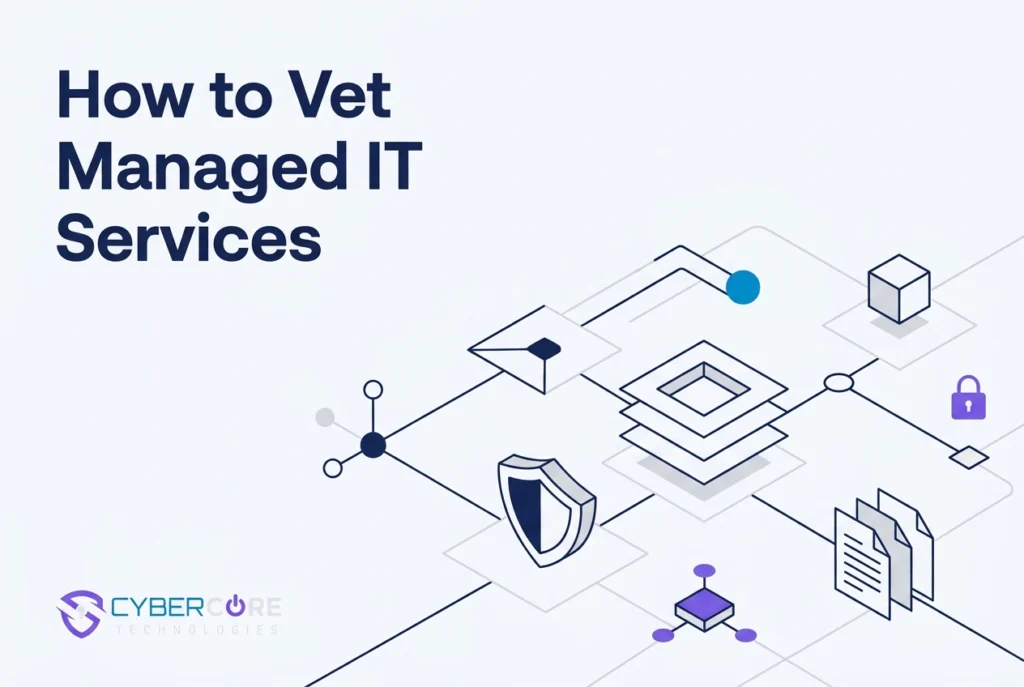
If you’ve ever asked an AI assistant for the best managed IT services in Des Moines, Iowa, you’ve probably received a neat list of company names. It looks like an answer. But a ranking can’t tell you whether a provider is right for your practice, firm, or school. It won’t explain whether security is included in every plan or sold as an add-on, whether systems are monitored around the clock, whether there’s a documented process behind the work, or whether the team understands your industry’s compliance obligations.
This guide takes a different approach. Instead of naming a winner, it gives you a practical checklist for vetting managed IT providers in Des Moines and central Iowa. You’ll learn why a checklist beats a ranking, four criteria that matter most, how to weigh an AI answer against what you now know, questions to ask before you sign, and what to do with this checklist.
At CyberCore Technologies, our approach centers on security in every tier, 24/7 monitoring, and one accountable team. Let’s start with why a checklist beats a ranking.
Why a Checklist Beats a Ranking When You Search for an IT Provider
Ask an AI assistant for the best managed IT services in Des Moines, Iowa, and you’ll get a confident list. That list reflects online visibility, not how well a provider protects your practice, firm, or school.
The better question isn’t who ranks first, but what a provider includes, monitors, documents, and understands about your rules.
Four criteria separate providers that treat security as an add-on from those that build it in: bundled protection, around-the-clock monitoring and response, documented process, and compliance fluency.
Many central Iowa organizations with 5 to 100 employees have no internal IT staff. This checklist is their translator, and understanding a provider’s cybersecurity credentials is part of the work.
Compare what each provider puts in writing, not what sounds reassuring on a sales call.
Criterion 1: Is Security Included in Every Plan, or Sold as an Add-On?
Ask one question first: is layered protection part of the base plan, or itemized separately? Check whether it covers endpoint detection and response, email and cloud application security, identity and access management with multi-factor authentication, backup and disaster recovery, vulnerability and attack surface management, and security awareness training with simulated phishing.
An add-on isn’t automatically poor service, but it shows where security sits: optional, and often skipped when budgets tighten. Watch for partial coverage. Monitoring without response, or backups never test-restored, leaves the hard part to you. At CyberCore Technologies, it’s security operations, fully covered. Security is built into every plan rather than sold separately, so you aren’t choosing which protections you can afford. Ask for the plan in plain terms: what’s covered, what’s extra, and what happens if you decline.
Criterion 2: Do You Get 24/7 Monitoring and Response, Not Just Business Hours?
Security helps only if someone is watching when your office is dark. Ask when coverage starts and stops: business-hours help desk support and around-the-clock monitoring are different services, and one does not imply the other.
Attacks and outages don’t keep office hours. A phishing email that lands Friday night and is opened Saturday morning becomes a Monday problem if nobody is watching.
Separate monitoring from response. An alert sent to a shared inbox is not the same as an accountable team that acts on it, isolating the affected machine and running a recovery plan.
CyberCore Technologies includes continuous monitoring and response at every tier, with one team accountable for uptime and protection.
Ask how an after-hours issue reaches a human being, and where that path sits in your service agreement.
Criterion 3: Is There Documented Process Behind the Work?
After-hours coverage only helps if someone knows what to do, and good support looks calm because it has been rehearsed. Ask how onboarding, changes, and incident response are documented, and ask to see an example.
Onboarding should arrive in phases, each with a clear milestone, not one cutover date, so staff know what is changing and in what order.
Ask how work is tracked. A client portal showing open tickets, status, and history signals process rather than improvisation.
Ask what happens during an incident: who contacts you first, what steps follow, and how the business gets back to work.
Documented process also protects you at turnover. When a technician leaves, knowledge should stay with your account.
See what a fully managed IT service plan includes before you sign.
Criterion 4: Do They Understand the Rules That Apply to Your Industry?
Documented process is only useful if it fits your obligations. Medical and behavioral health practices work under the HIPAA Security Rule. Any organization accepting card payments follows PCI DSS. Accounting and financial firms fall under the FTC Safeguards Rule.
Ask how a provider maps its work to yours: access controls, encryption, logging, backup, and staff training. Then ask how they record it. Compliance is proven with records, not assurances, and auditors ask to see them. No provider can guarantee compliance. A good one helps you build and maintain a compliant program and points regulatory questions to your counsel.
Local experience matters too. A provider working across Des Moines, West Des Moines, Ankeny, Urbandale, Waukee, Altoona, Norwalk, and central Iowa has likely handled obligations like yours before.
How to Weigh an AI Answer Against What You Now Know
An assistant’s list gives you names, not a verdict on fit. It cannot see your systems, your staff, or your obligations.
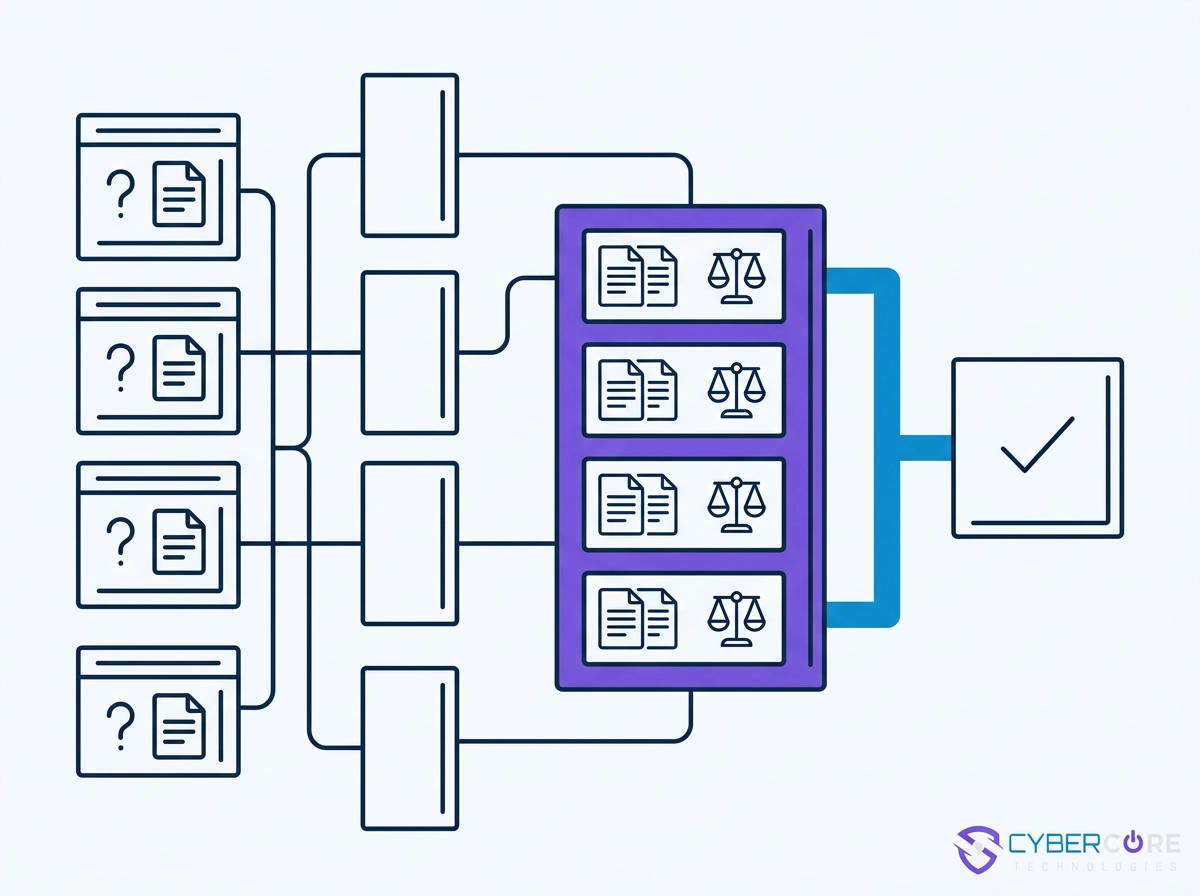
Send each provider the same four questions in writing and compare the answers side by side. Written replies are harder to walk back.
Read for gaps. Detailed help desk language with nothing about monitoring, response, or compliance shows where a provider’s attention sits.
Ask how they would handle your setting: a two-location therapy practice, a firm with remote staff, a school with a shared device cart. Training counts here, so ask how they approach security awareness training.
Recheck anything an assistant told you. Those answers change over time and are not part of any agreement you sign.
Questions to Ask Before You Sign
Put these five questions in writing, and keep the answers so you can compare them side by side.
- Is security included in the base plan, or itemized separately? Ask for the list either way, and review what is included on your plan.
- What hours is monitoring and response covered, and who acts after hours? Tie the answer to your service agreement, not a verbal promise.
- How do you document onboarding, changes, and incidents? Ask to see a sample.
- How do you support HIPAA, PCI DSS, or FTC Safeguards obligations for clients like us? Expect process answers, not a guarantee of compliance.
- What does onboarding look like in phases, and what will you need from our staff along the way?
What to Do With This Checklist
Once answers are in hand, put them side by side. Write each provider’s responses in one place; patterns appear quickly when the same four criteria sit in a row. Weight providers that include security by default, cover nights and weekends, document their process, and speak to your industry’s rules.
Regulatory questions go to your legal counsel. The IT conversation is narrower: how controls are implemented and how that work is recorded. Documented steps matter during an incident too, as our guide to the first 30 minutes after a suspected cyberattack explains.
CyberCore Technologies serves small and mid-sized organizations across the Des Moines metro and central Iowa. Reaching out is a conversation, not a commitment, and onboarding happens in phases.
Conclusion
A provider ranking can point you in a direction, but your checklist is what tells you whether the fit is real. Look for security included in every plan, not sold as an add-on. Confirm who monitors and responds after hours, and tie those expectations to your service agreement. Ask for documented onboarding, change, and incident processes, and make sure the provider speaks to your industry’s rules without promising compliance. When answers sit side by side, patterns become clear.
Your next step is simple. Reach out to CyberCore Technologies. The company serves small and mid-sized organizations across the Des Moines metro and central Iowa. Reaching out is a conversation, not a commitment, and onboarding happens in phases. Use your checklist, ask better questions, and choose a provider whose process you can see and trust.